
The whispers began like a faint rustle behind closed doors, the kind that Bollywood families have spent decades learning to silence. Yet this time, something slipped through the cracks. A rumor, a confrontation, a moment between Sunny Deol and Hema Malini that no one expected and everyone is now talking about. What happened, why it happened, and why now, has sent a ripple across an industry that feeds on nostalgia but hides its wounds behind camera-ready smiles.
For years, the Deol family stood as a symbol of disciplined privacy. Dharmendra, the larger-than-life star whose smile lit up a generation, had built a world supported by two women: Prakash Kaur, his first wife, the quiet pillar who stayed away from the media; and Hema Malini, the dream girl of Bollywood, who shared his life through a union wrapped in both admiration and controversy. The two households lived parallel lives, rarely intersecting, never acknowledging the unspoken tension that everyone knew but no one addressed. The children grew up in that quiet divide, especially Sunny and Bobby, whose loyalty toward their mother was as unshakeable as their silence about their father’s second marriage.
Silence can be graceful. Silence can also be heavy. And sometimes, after decades, it cracks.
Those close to the family say the alleged confrontation between Sunny Deol and Hema Malini was not a dramatic explosion, but something more painful and deeply human. It was a conversation long overdue. A moment where buried emotions rose to the surface, where the wounds of the past met the realities of the present. People who witnessed the tension claim Sunny carried with him years of hurt, frustration, and the relentless pressure of keeping the peace between fractured worlds. And Hema Ji, a woman who has endured her share of public judgment and private loneliness, stood her ground with the grace she has always been known for.
The heart of the matter, insiders suggest, was not anger but exhaustion. Dharmendra’s recent health concerns, combined with the emotional strain on Prakash Kaur, reopened old memories Sunny had spent his entire life trying to bury. Children often inherit their parents’ battles, even when they never asked for them. Sunny, fiercely protective of his mother, had spent years avoiding any confrontation that could deepen old wounds. But now, with time catching up to everyone, the unsaid words finally found their voice.
Those present say the conversation centered around Dharmendra’s emotional absence during critical moments in Prakash Kaur’s life. Sunny allegedly questioned why these moments were brushed aside, why responsibilities were divided unevenly, why the emotional weight always seemed heavier on one side of the family. He demanded acknowledgment not for himself, but for the mother who had endured everything silently.
Hema Ji, on her part, expressed her own truth. She spoke of a marriage lived in fragments, of love overshadowed by the constant reminder that she could never fully claim the man she adored. She reportedly told Sunny that she, too, had spent a lifetime standing slightly outside the frame, loved yet criticized, cherished yet resented. Two worlds, both hurting, both incomplete, collided in that moment, not out of hatred but the undeniable need to be seen.
Bollywood families often operate like well-kept gardens: the flowers are always perfectly arranged, the walkway spotless, the facade immaculate. But behind the hedges lie decades of pruning, cutting, shaping, sacrificing. What outsiders see is only the final picture, never the hands that bled to maintain it.
The Deols have always been masters of maintaining that image. Through film promotions, public appearances, and carefully curated interviews, they projected unity even when life was far more complex. Fans never questioned why Sunny and Bobby rarely appeared with Hema Malini. They never wondered why family gatherings were always selectively shown. Bollywood was content with the illusion. The fans embraced the nostalgia. And the family continued its quiet dance around unanswered questions.
But time changes everything.
Those close to Sunny say this confrontation was not about disrespect. It was about closure. A lifetime of carrying the emotional weight of two households had hardened him, but it had also left him with a deep longing for truth. People who know him describe him as stoic, disciplined, and deeply private. Yet beneath that exterior lies a son who witnessed his mother navigate loneliness with dignity. A son who watched his father live in two worlds but was allowed to fully belong to only one. A son who grew up loving a man he could not completely understand.
And then there is Hema Ji, who has lived her entire adult life balancing admiration and judgment. A woman who rose to fame as India’s dream girl yet found her real life marked by sacrifices invisible to the public. Her relationship with Dharmendra was adored by fans but complicated by reality. For decades she remained graceful, polite, soft-spoken, a woman who rarely let her emotions spill into the public eye. But even she, those present say, felt the weight of the moment when Sunny stood before her, no longer the quiet son who kept his distance, but a man seeking answers.
Sources say the conversation did not end in anger. There were raised voices, yes, and long pauses filled with the kind of heaviness that only decades of unspoken truth can create. But in the end, there was understanding. There was acknowledgement of pain on all sides. There was, perhaps for the first time, a mutual recognition that love, in this family, had always been more complex than it appeared.
As the story explodes across Bollywood circles, the public is left to speculate. Was this confrontation a sign of old wounds reopening or a step toward long-awaited healing? Are the Deols finally facing the truths they kept hidden to protect their legacy? Or is this just the beginning of a far deeper unraveling?
The answers are still unfolding. But one thing is certain: silence, no matter how carefully preserved, eventually demands to be broken.
The days following the confrontation moved slowly, coated with the kind of tension that makes even silence feel loud. Those within the Deol household described a shift in the air, a subtle change that suggested something irreversible had occurred. Conversations felt heavier. Phone calls lingered longer. Every gesture seemed to carry an unspoken question. The confrontation between Sunny Deol and Hema Malini had not only cracked decades of silence but also disrupted the delicate balance the family had learned to maintain.
Inside Dharmendra’s home, the atmosphere was especially tender. The veteran actor, once the symbol of boundless energy and charm, now spent most of his time in calm corners, increasingly dependent on the emotional presence of his children. When he learned about the tension between Sunny and Hema Ji, those close to him say he fell into a long, contemplative quiet. To outsiders he has always appeared fearless, decisive, a hero in every sense of the word. But this time, the conflict involved two people he loved in different but equally profound ways.
People around him shared that Dharmendra seemed torn between the life he had chosen and the life he had broken along the way. He had built a home with Prakash Kaur filled with childhood laughter, shared struggles, and the honest simplicity of early stardom. And later, he built a second life with Hema Malini filled with glamour, admiration, and a kind of companionship that transcended labels. Both were real. Both were meaningful. But the coexistence of the two had always come with a cost, even if he rarely admitted it.
Sunny’s confrontation forced Dharmendra to revisit memories he preferred to leave untouched. The nights when he returned home late, torn between responsibilities. The moments he missed because he could not be in two places at once. The pain in Prakash Kaur’s eyes that she hid for the sake of her children. The isolation Hema Malini felt when society judged her more harshly than him. It was a life made of choices that had shaped the destiny of everyone involved.
Those close to the family say Sunny initially distanced himself from further discussions. He had said what his heart carried for years, and the emotional weight of that release left him exhausted. Work became his anchor. His film commitments, political responsibilities, and gym routines provided structure in a moment when everything else felt fragile. But internally, he wrestled with questions that had no simple answers. Had he gone too far? Had he finally spoken a necessary truth? Or had he opened a wound his family was not ready to address?
Meanwhile, Hema Ji was also navigating her own emotional aftermath. Though composed on the surface, she felt shaken by the confrontation. For decades she had accepted her role in the family’s unusual dynamic, believing that time would eventually smooth over the rough edges. The confrontation with Sunny brought back memories of times she felt misunderstood, vilified, or reduced to a stereotype by the outside world. She remembered the loneliness of festivals celebrated with half a family, the whispers that followed her everywhere, the constant balancing act between being a public figure and a private person.
Yet those who know her say she did not hold anger. Instead, she felt a deep ache that comes from realizing that even after all these years, wounds remained unhealed on all sides. She confided in close friends about the confrontation, speaking not with resentment but with a quiet acceptance that the complexities of their shared history could never be fully erased.
The situation grew more delicate when Prakash Kaur learned of the confrontation. Sources say she received the news with her usual grace—calm, composed, dignified. She had always believed that silence was the family’s greatest form of protection. But hearing that Sunny had spoken out stirred emotions she rarely allowed herself to feel. Those around her say a mix of pride and sadness washed over her. Pride that her son had defended her without hesitation. Sadness that after decades of maintaining peace, the family’s unspoken understanding had finally been disrupted.
Even Bobby Deol, often seen as the gentlest heart in the family, felt the tremors. He had grown up idolizing his elder brother and respecting Hema Ji from a quiet distance. The confrontation left him torn between loyalty and empathy. Friends say he tried to mediate indirectly, encouraging calm conversations without choosing sides. But even his presence could not restore the fragile equilibrium that had been shaken.
As the days passed, whispers from the industry began shaping their own narrative. Some claimed the confrontation exposed the emotional fractures Bollywood families often disguise. Others whispered that this could be a path toward long-awaited healing. A few insiders speculated that the family was on the verge of a public reconciliation, while others claimed the rift had widened too much to close. The truth, however, remained within the walls of the Deol and Malini households.
Then came the moment that surprised everyone.
Dharmendra, after days of contemplation, initiated a private meeting between Sunny and Hema Ji. It was not planned with grand gestures or emotional ultimatums. It was a father’s quiet attempt to mend the threads that had begun to fray. Sources say he reached out to both separately, asking them—not as public figures but as people he loved—to sit with him for a conversation. The request carried the weight of his age, his regrets, and his desire to leave behind peace rather than unresolved pain.
The meeting took place in a quiet room, free from cameras, free from onlookers. Just three people connected by love, hurt, history, and a lifetime of complicated decisions. Dharmendra reportedly spoke first, acknowledging his own shortcomings without excuses. He expressed his deep gratitude toward both women who had shaped his life in different ways and admitted the emotional weight his children had carried because of his choices.
Sunny listened, his expression shifting between vulnerability and restraint. Hema Ji listened too, her eyes reflecting the emotions she rarely allowed to surface. There were long pauses, heavy breaths, and moments when words seemed inadequate. But the conversation was real. Honest. Human. Perhaps the first time in decades that the three of them shared a moment free of pretense.
No one outside the room knows exactly what was said. But those closest to the family believe something softened that day. A layer of tension loosened. A bridge, once broken, found the hint of a foundation.
The world, however, sees only the headlines. The trending hashtags. The speculation. What they do not see is the emotional labor happening behind closed doors. The courage it takes to confront history. The pain of acknowledging truths buried for years. The delicate process of healing a family shaped by love, choices, and unspoken sacrifices.
The morning after the meeting felt different in both households, though neither could fully explain why. Something had shifted. Not entirely mended, not entirely broken—something in between. Sunny woke early, as he always did, but his routine felt altered, as if the weight he had carried for years finally had a place to rest. He stood in front of the mirror, running a hand through his hair, studying his own reflection with a quiet intensity. He looked older than he felt and younger than he feared. Behind his eyes was relief, but also uncertainty. Healing, he realized, wasn’t instant. It was a process that demanded patience, even from a man who had built his life on discipline and resolve.
Meanwhile, across the city, Hema Malini sat in her garden, listening to the soft rustle of palm leaves. The early sun warmed her face, and for the first time in days, she felt something close to peace. She had not cried during the meeting, though her heart had trembled beneath her calm exterior. She thought about Dharmendra’s voice as he admitted his regrets—how it cracked just slightly, how the air seemed to shift when he acknowledged the pain everyone had carried. More than anger, she felt tenderness. Tenderness for the young woman she had once been, for the choices she had made, for the life she had built, sometimes quietly, sometimes boldly, but always authentically.
Prakash Kaur, upon hearing that the meeting had taken place, remained silent for a long time. She sat with her cup of tea, letting the steam rise gently toward her face. Those who knew her well said she carried a strength that did not need volume. She understood that conversations like these were necessary, even if they reopened old wounds. For her, the confrontation was not a battle won or lost; it was a reminder of the complex human heart—the heart of a woman who had lived her entire life choosing dignity over bitterness. She whispered a small prayer for peace, not for herself, but for her son, for her family, and even for the woman whose existence had once fractured her world.
Dharmendra, however, could not shake the emotional intensity of the previous night. He had gone to bed with a heaviness that felt like both relief and regret. Age had softened him, but it had also made him painfully aware of time. He spent the morning staring out of his window, watching sunlight spill across the garden. He knew the seeds for reconciliation had been planted, but seeds needed care, patience, and vulnerability—things he had not always offered freely. Still, he felt grateful. For his children’s strength. For the women who had loved him despite the storms he brought. For the chance, even at this stage in life, to ease the emotional burdens he had unintentionally created.
What the public continued to see, however, was the opposite: a growing frenzy of reports, unverified rumors, and sensationalized stories. Headlines claimed the family was “on the verge of collapse.” Others insisted a “full-blown war” was underway. Social media amplified every whisper, turning fragments of truth into dramatic narratives. But the reality unfolding behind closed doors was far more delicate, deeply human, and infinitely more complex than any paparazzi lens could capture.
In the days following the meeting, Sunny made a quiet decision. He drove to his father’s home unannounced. The staff let him in without question, sensing something significant. When Sunny entered the room, Dharmendra looked up, surprise flickering across his face before morphing into emotion. No words were exchanged at first. Sunny simply walked over and sat beside him. They remained in silence, but it was a different kind of silence—no longer heavy, but warm. Dharmendra eventually placed a hand on his son’s back, a gesture so simple yet powerful that it carried the weight of decades.
During their conversation that followed, there were no accusations, no explanations demanded or offered. Instead, they spoke about things they rarely allowed themselves to express. Responsibility. Regret. Love. The pain of past mistakes. The hope for a quieter future. Sunny admitted that his anger came not from resentment toward Hema Ji, but from the long-standing ache he had watched his mother endure. Dharmendra listened, truly listened, with the humility of a man who knew his son was not wrong.
On the other side of the story, Hema Ji also felt compelled to act. She called Bobby first, knowing he was the emotional anchor who could bridge any distance. Their conversation was soft, reflective. She thanked him for always showing kindness, even when silence felt safer. She then expressed her willingness to meet Sunny again, not for confrontation but for understanding. Bobby agreed to help facilitate it when the time felt right. For the first time in a long while, the word “family” felt possible between them.
The real turning point, however, came unexpectedly.
A private photo surfaced, not leaked by media but shared intentionally by someone inside the family. It showed Dharmendra seated in his garden, sunlight touching his shoulder. Standing behind him—with a quiet, almost imperceptible closeness—were Sunny and Hema Ji. They were not smiling broadly. They were not posing for the world. They simply existed in the same frame, united by a bond deeper than headlines could define.
The image stunned Bollywood.
It wasn’t an announcement of peace, nor a denial of conflict. It was a moment suspended in truth: fractured relationships acknowledging their shared roots. Fans reacted with emotion, realizing that behind decades of glamour lay the raw, unpolished reality of a family trying to heal.
In the coming weeks, the family re-established their private boundaries. They did not make joint statements. They did not give interviews. They simply allowed time to do its quiet work. And slowly, the sharp edges softened. Communication became gentler. Emotions became more manageable. The family’s decades-old wounds did not disappear, but they became less defining, less suffocating.
The Deols, for the first time in years, were not hiding from their truth. They were growing through it.
This was not a dramatic reconciliation. It was not a public spectacle. It was something far more meaningful: a willingness to try again. A willingness to love, imperfectly but sincerely. A willingness to allow the past to coexist with the future.
And in that soft, unspoken willingness lay the real heart of the story—one the world rarely sees, but one that matters most.
News

Bigg Boss 19 Shocker: Tanya Throws Ink at Farrhana
The Bigg Boss 19 house had been simmering with tension all morning. The contestants moved around cautiously, aware that the…

Bigg Boss 19 Weekend Ka Vaar Promo: Shocking Eviction Revealed
The Bigg Boss 19 house had never felt so tense. The morning sunlight filtered through the windows, casting long shadows…

Shock in Dharmendra’s Family as Last Will Revealed
The room was heavy with anticipation. A single, unassuming envelope sat on the polished wooden table in Dharmendra’s family home,…

Bigg Boss 19 Shocker: Farrhana Throws a Mug at Tanya
The Bigg Boss 19 house had always been a pressure cooker of emotions, but today, the atmosphere was thick with…
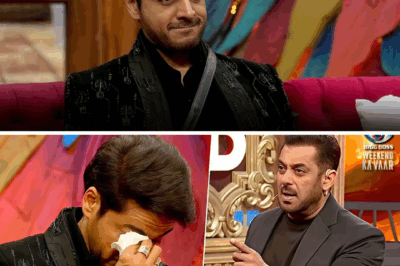
Bigg Boss 19 Shock: Salman Khan Offers Gaurav a Role in His Next Movie
The Bigg Boss house was already buzzing with anticipation as the weekend episode approached. Contestants were aware that Salman Khan’s…

Amitabh Bachchan Breaks Down Over Dharmendra Ji’s Death: Emotional Tweet Sparks Sensation
The news of Dharmendra Ji’s passing had sent shockwaves through Bollywood and the nation. Among the many mourning the legendary…
End of content
No more pages to load