
The hall was silent, lit only by the soft glow of white candles arranged in a perfect arc around Dharmendra’s framed photograph. The legendary actor’s smile, immortalized in that single picture, held a quiet warmth that made nearly everyone present wipe away tears. Hundreds had gathered for the prayer meet, from old colleagues to new-age stars who had grown up watching his films. Yet amid the familiar faces, one absence stood out like an empty chair in a full auditorium. Hema Malini, the woman whose name had been entwined with Dharmendra’s for more than half a century, was nowhere to be found.
Rumors spread before the ceremony even began. “She must be unwell,” someone whispered. “Maybe the family didn’t want another scene,” another muttered. But it wasn’t until the prayer meet concluded that the truth—heavy, emotional, and deeply human—began to surface. A truth that spoke not of distance, but of a bond so profound that even presence could feel unbearable.
For Hema Malini, the world saw a dream girl, a star, a graceful woman who always carried herself with poise. But behind that poise was a heart that had lived through decades of quiet storms. Dharmendra’s passing wasn’t just the end of an era; it was the loss of a partner who had shaped her life in ways few truly understood. According to a close family source, the moment she received the morning phone call confirming that Dharmendra ji had taken his final breath, she collapsed into her daughter’s arms. It was not grief that made her weak. It was the wave of memories—beautiful, hidden, and painful—that came crashing all at once.
While the world imagined their relationship as a fairytale laced with glamour, the truth was far more complex. Their love story had always been layered, a mix of passion and sacrifice. Hema Malini had once said in a rare interview, “We built a world that was ours, even if it didn’t fit into anyone else’s definition.” Those words, now echoing in the minds of millions, painted a clearer picture of why she could not bring herself to stand before his photograph at the prayer hall.
Her daughters, Esha and Ahana, attended on her behalf. Both were visibly distressed, yet they kept their composure, offering folded hands to every guest. At one point, Esha was seen wiping a tear before stepping onto the stage. She didn’t speak, but her eyes said everything—a daughter grieving not just for her father, but also for her mother’s unseen pain. She reportedly told a close friend, “Mama couldn’t bear to see him like that. She wanted to remember him alive, smiling, scolding, laughing.”
But the reveal that left everyone stunned came hours later, when a family member traveling with the ambulance from the hospital shared what had happened the previous night. Hema Malini had insisted on seeing Dharmendra ji privately, away from cameras, away from chaos. When she walked into the dimly lit room where his body had been kept, she froze. Not because she was afraid, but because she felt an overwhelming swell of memories—her first film with him, their secret moments on set, their midnight conversations, his jokes that only she understood, the way he would look at her with that half-smile that needed no explanation.
She reportedly held his hand for nearly twenty minutes. No words. No movement. Just silence filled with decades of love. Then she said, “I’ll come again tomorrow. I just need strength.” But by the next morning, when the time for the prayer meet came, that strength had vanished. She was inconsolable. The doctor who attended her later said she experienced an emotional collapse severe enough to require medication.
And that is why she didn’t attend.
Not because of family issues.
Not because of drama.
Not because of the media glare.
But because her heart simply couldn’t bear the sight of saying goodbye twice.
Those close to her say she spent the entire duration of the prayer meet inside her prayer room at home. She lit a single diya and sat in silence, eyes closed, whispering prayers through tears. Every so often, she wiped her face and looked at Dharmendra ji’s photograph on her personal altar. She didn’t want cameras capturing her grief. She didn’t want her pain turned into headlines. All she wanted was to grieve like a wife—quietly, deeply, and without interruption.
When news reporters outside her home asked why she was missing from such an important ceremony, her relative simply said, “Her bond with Dharam ji was not for the public. Today she wanted to be with him in her own way.”
And perhaps that is the most powerful truth. Sometimes the loudest grief is the quiet one. The one behind closed doors. The one that doesn’t need public proof. The one that reminds us that love, no matter how imperfect, leaves a wound that only the heart carrying it can understand.
Tonight, even as fans across the world mourn Dharmendra ji’s passing, it is Hema Malini’s silent heartbreak that has left millions emotional. A heartbreak that says love does not end with death. It lingers. It aches. It whispers. And it reminds us that some goodbyes are too heavy to witness.
The second day after Dharmendra ji’s passing brought a strange calm to Mumbai. Outside the Deol residence, dozens of fans and reporters gathered again, waiting for the next wave of updates. But inside Hema Malini’s Juhu home, the atmosphere was entirely different. Heavy curtains blocked the morning sun, and the fragrance of incense filled every corner of her prayer room. Hema sat cross-legged on a small mat, eyes swollen, hair loosely tied, the weight of memories pressing down on her shoulders.
Those closest to her had always known she processed grief differently. She didn’t cry loudly. She didn’t break down in front of people. She withdrew into silence, into the sanctity of rituals, into the quiet corners of her heart. But this time, her silence carried something deeper—something she had been holding back for years.
A source very close to the family finally revealed the truth that left everyone stunned. The reason Hema Malini avoided the prayer meet wasn’t just emotional collapse; it was also connected to an old wound—an unspoken tension that had never fully healed, even after decades. A tension involving Dharmendra’s first family, his sons Sunny and Bobby, and the fragile balance that held their blended realities together.
For years, Hema and the Deol brothers had navigated a silent understanding. Respectful. Distant. Carefully maintained. It wasn’t hostility—far from it. It was a mutual awareness that their worlds, though connected by one man, were built on different foundations. Dharmendra ji, in his lifetime, had done everything he could to keep the peace. He visited both homes, supported both families, loved all his children. But even the greatest hearts cannot erase the scars of complicated beginnings.
The night Hema Malini saw Dharmendra’s body in private, something inside her broke—not just from sorrow but from the realization that she could no longer lean on the person who had held both families together with sheer force of love. She knew that the prayer meet, filled with cameras and extended relatives, would be a delicate environment. One wrong moment, one emotional collapse, and the media would twist it into a spectacle.
But there was another, far more painful reason she stayed home—one she had never intended to reveal.
A close associate of Hema Malini shared that in her final private moment with Dharmendra ji, she confessed something out loud—a truth she had carried for years. “I never wanted your children to feel I took you away from them,” she whispered to his still form. “That guilt never left me.”
This guilt, buried deep in her heart, resurfaced with overwhelming force the morning of the prayer meet. She feared that her presence, rather than offering tribute, might ignite unnecessary conversations, misunderstandings, or even emotional friction. She didn’t want her grief compared. She didn’t want anyone thinking she was claiming space that didn’t belong to her. Above all, she didn’t want Sunny and Bobby to feel overshadowed by her presence on the most sensitive day of their lives.
But fate had one more twist. When Sunny Deol learned that Hema Malini had skipped the prayer meet, his reaction surprised everyone. He didn’t respond with anger or coldness. Instead, he seemed quietly affected. A crew member who was present near the entrance revealed that Sunny stepped aside from the gathering, took a deep breath, and wiped his eyes. “Whatever it is,” he said softly to a friend, “I hope she’s okay. Papaji cared for her a lot.”
It was a small moment—barely noticed by the crowd—but it carried decades of unspoken acknowledgement.
Yet another revelation surfaced later in the evening, one that painted the picture even more clearly. A family insider disclosed that Sunny had personally asked organizers to keep the proceedings dignified and to avoid any confrontational environment. He made it clear that the prayer meet was not the place for unresolved family matters, stressing that everyone’s grief should be respected equally.
Ironically, that very intention—maintaining peace—is precisely what kept Hema Malini at home.
She believed her absence would make the day smoother for everyone. “The children need this moment,” she reportedly told a confidante. “Let them have their father without distraction.”
The confidante, who had known her for over 30 years, described the scene: Hema sitting on the floor, clutching Dharmendra ji’s favorite white shawl, tears silently streaming down her face as she whispered prayers for his soul. “She was grieving as a wife,” the confidante said, “but she was also grieving as a woman who had lived half her life in careful shadows.”
For the first time in decades, she allowed herself to feel the loneliness of that position.
As the prayer meet concluded miles away, Hema remained in her home temple. She didn’t check her phone. She didn’t turn on the TV. She didn’t ask who attended. All she wanted was to sit beside the small silver-framed photo of Dharmendra ji on her altar, light a diya, and hold the memory of the man she loved—not the superstar, not the head of two families, but the gentle soul who had once looked at her during a film shoot and said, “I don’t know why, but I feel alive when you smile.”
By evening, social media had exploded with speculation. Some criticized her absence. Others defended it. But none truly understood the layers beneath—the love, the guilt, the silent sacrifices, the delicate balance she had maintained for years.
And perhaps that is the tragedy of celebrity stories: the world sees the surface, but the real stories—the human ones—live hidden behind closed doors, in whispered prayers, in private tears, and in the quiet corners of the heart where love survives even after goodbye.
The third day after Dharmendra ji’s passing felt strangely heavier than the first two. The rituals were done. The guests had gone. The house that had echoed with prayers and whispered condolences now sat under a blanket of almost unsettling quiet. But beneath that silence, a story was unfolding that only a handful of people knew. A story of closure, confrontation, and a moment of unexpected healing—one that the world might never have imagined.
While the media focused on Hema Malini’s absence from the prayer meet, something far more intimate was happening behind the scenes. Sunny Deol, still reeling from the emotional storm of the previous days, made a decision that surprised even those closest to him. That evening, just after sunset, Sunny arrived at Hema Malini’s home. No cameras. No entourage. No announcement. Just a quiet knock on the door.
It was Ahana who opened it. The moment she saw him, her face softened—not out of surprise, but relief. “Mama is inside,” she said gently, her voice carrying a mixture of exhaustion and gratitude. For a second, Sunny hesitated. He wasn’t sure how the meeting would unfold. Years of distance had turned even simple moments into delicate ones. But tonight was different. Tonight, grief had stripped away everything except the raw truth they all shared—they had lost the same man.
When Sunny stepped into the prayer room, he found Hema Malini sitting on the floor, the diya still flickering beside Dharmendra ji’s framed photo. The room was dim, lit only by the warm glow of the small lamp. Hema didn’t immediately look up. Her fingers were wrapped around a small rudraksha mala, moving bead by bead in slow, shaky motions.
It wasn’t until she felt Sunny’s presence that she finally raised her head. Their eyes met—two people connected by the same man, separated by years of unresolved emotions. For a moment, neither spoke. The quiet hum of incense filled the silence between them.
Then Sunny stepped forward and folded his hands respectfully. “I came because…” He paused, searching for words he had never spoken before. “Papaji cared for you. A lot. And I know you loved him too.”
Hema’s eyes instantly welled up. She bowed her head, tears slipping onto the fabric of her saree. “I couldn’t come,” she whispered, voice breaking. “I wanted to… but I just couldn’t bear seeing him there again. I didn’t want anyone to think I was trying to take your moment away.”
Sunny slowly knelt down before her. “No one would’ve thought that,” he said softly. “Not me. Not Bobby.”
The simplicity of his words cracked something inside her—something she had been gripping tightly for decades. All the years of walking carefully, trying not to overstep, trying to respect boundaries, trying to protect her daughters from the weight of history… suddenly felt unnecessary in this small, sacred room.
“I always tried to stay in my place,” she murmured. “I never wanted you or Bobby to feel overshadowed.”
Sunny shook his head gently. “Papaji made mistakes. But he also loved deeply. He didn’t want any of us to carry bitterness. He wanted peace.”
It was the first time in years that they spoke openly about the invisible walls that had shaped their lives. Not angrily. Not defensively. Just honestly.
A few minutes later, Esha and Ahana quietly joined them. The four sat together in front of Dharmendra ji’s photo—something that had never happened before. Esha placed her hand on her mother’s shoulder. Ahana offered a small smile through her tears. And Sunny, eyes red but steady, folded his hands in prayer.
For nearly fifteen minutes, they sat in silence, united by the one bond that had always existed but never been acknowledged so openly.
When the prayer ended, Sunny reached into his pocket and pulled out a small envelope. “Papaji kept this in his drawer,” he said, placing it gently in Hema’s hands. “I think it was meant for you.”
Hema hesitated, her fingers trembling as she opened the envelope. Inside was a short handwritten note—faded, shaky, but unmistakably Dharmendra’s writing.
It said:
If one day I go before you, remember me smiling. Not crying. You gave me peace in a world full of noise.
The moment she read it, she broke down. Not in the controlled way she had done earlier, but with years of unspoken emotion pouring out. Sunny placed a comforting hand on her back, gently patting her shoulder the way a son might do for someone he finally saw as part of his world.
This moment—unexpected, intimate, almost sacred—became the true closure Hema never got at the public prayer meet.
Later that night, after Sunny left, Esha sat beside her mother. “Mama, it’s okay,” she whispered. “You don’t have to carry this alone anymore.”
Hema looked at her daughters and finally nodded. She realized that love, no matter how complicated, does not need to be hidden forever. That grief, shared even once, can soften years of silence. And that somewhere, in the middle of loss, a small bridge had been built between two halves of a family that had always been kept apart.
The next morning, when reporters outside speculated endlessly about family drama, none of them knew the truth—that inside that quiet home, something healing had happened. Something Dharmendra ji would have wanted. Something he had waited years for.
A closure no camera captured.
A reconciliation no headline reported.
A final gift, born from his passing, that brought two families a little closer.
And in that moment, Hema Malini finally breathed—not as a star, not as the “other wife,” but simply as a woman who had loved, lost, and found unexpected peace in the most fragile moment of her life.
News

Bigg Boss 19 Shocker: Tanya Throws Ink at Farrhana
The Bigg Boss 19 house had been simmering with tension all morning. The contestants moved around cautiously, aware that the…

Bigg Boss 19 Weekend Ka Vaar Promo: Shocking Eviction Revealed
The Bigg Boss 19 house had never felt so tense. The morning sunlight filtered through the windows, casting long shadows…

Shock in Dharmendra’s Family as Last Will Revealed
The room was heavy with anticipation. A single, unassuming envelope sat on the polished wooden table in Dharmendra’s family home,…

Bigg Boss 19 Shocker: Farrhana Throws a Mug at Tanya
The Bigg Boss 19 house had always been a pressure cooker of emotions, but today, the atmosphere was thick with…
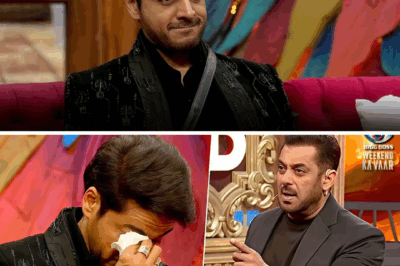
Bigg Boss 19 Shock: Salman Khan Offers Gaurav a Role in His Next Movie
The Bigg Boss house was already buzzing with anticipation as the weekend episode approached. Contestants were aware that Salman Khan’s…

Amitabh Bachchan Breaks Down Over Dharmendra Ji’s Death: Emotional Tweet Sparks Sensation
The news of Dharmendra Ji’s passing had sent shockwaves through Bollywood and the nation. Among the many mourning the legendary…
End of content
No more pages to load