Behind Closed Doors: How Esha Deol Fulfilled Her Father’s Final Wish
The sun had barely risen over Mumbai, and yet the Deol household was already awake. The air carried a hushed anticipation, a weight that no one outside the family could possibly understand. Inside, the walls seemed to hum with memories—echoes of laughter, arguments, and quiet guidance that had defined decades of the Deol legacy. Today was different. Today, Esha Deol would fulfill her father’s final wish, and the room, usually bustling with life and casual chatter, was quiet, reverent.
Esha moved through the house with deliberate calm, the kind of quiet strength she had inherited from her father. Dharmendra, legendary actor, charismatic father, and the anchor of the family, had passed away quietly weeks ago. His absence left a space so vast that even the familiar walls of the sprawling Mumbai home felt hollow. But it was more than just absence. His last words, recorded in private conversations and whispered in letters she found tucked away in his study, had been instructions—guidance meant for her alone. He had asked for something personal, something that would honor not just his life, but the unity of the family he loved fiercely.
Esha paused in the hallway, letting her fingers brush the polished wood of the staircase railing, tracing the familiar grooves worn smooth by years of family footsteps. She could almost hear her father’s voice reminding her to be precise, to pay attention to detail, to respect the sanctity of the moment. Dharmendra had always been larger than life on screen, a hero in celluloid and reel, but in private, he was meticulous and gentle, his love quietly overwhelming.
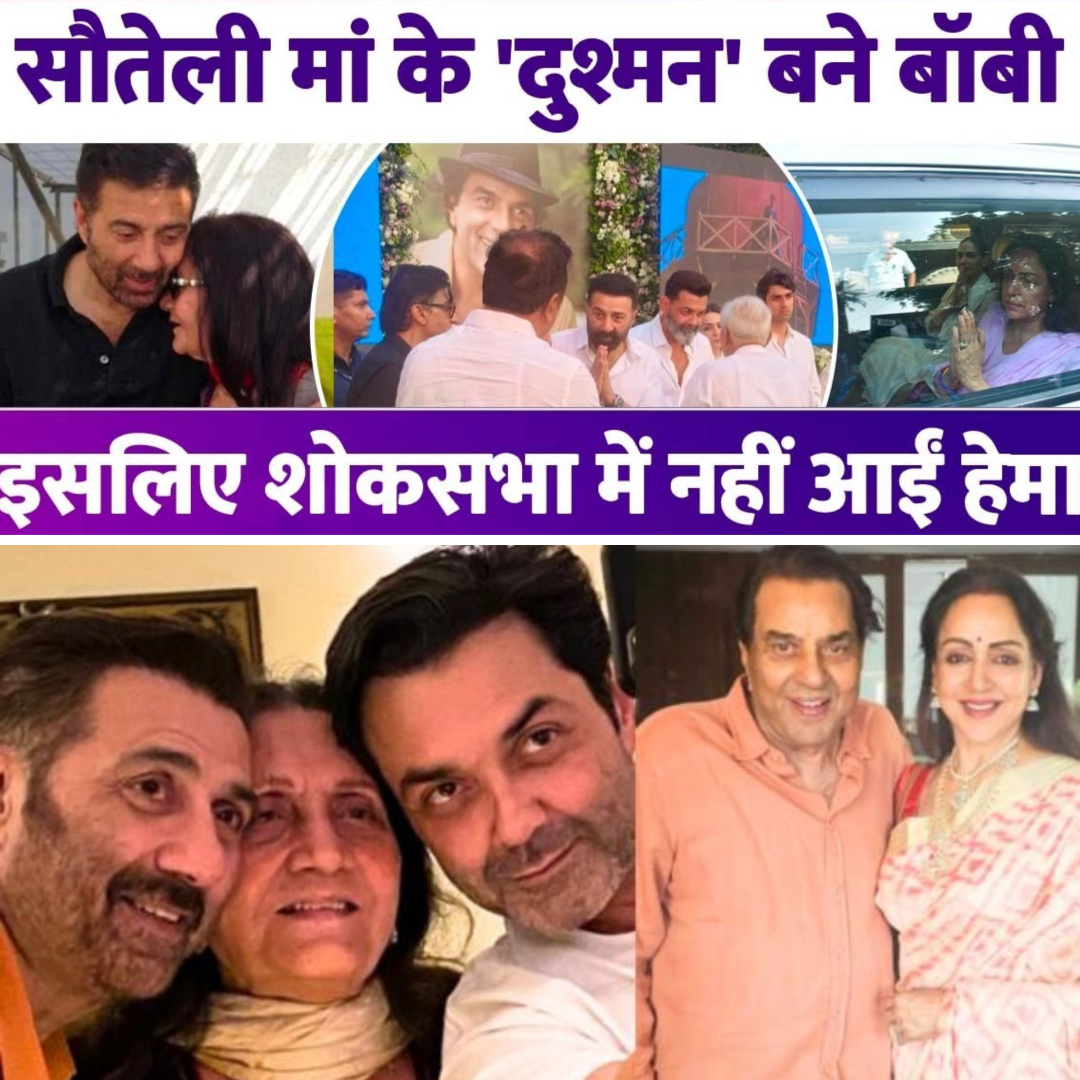
The living room was arranged with a careful balance of intimacy and solemnity. Family photographs lined the shelves, a silent chronicle of generations—the smiling faces of Sunny, Bobby, her mother, and moments she herself barely remembered. Every frame, every shadow, every corner seemed to watch her as she moved with purpose. The Deol family had gathered, but they were not there to perform for the cameras or public spectacle. There were no reporters, no fanfare, no Bollywood media sniffing for headlines. This was a moment for the family, a moment to reconcile loss and honor legacy.
Esha knelt before a small wooden chest in the center of the room. Her hands trembled for just a fraction of a second before she forced them steady. Inside lay a collection of Dharmendra’s personal letters, diaries, and mementos that had never been shared with the public. She lifted one carefully, feeling the weight of her father’s handwriting, the curves of letters that seemed so familiar yet distant now. The notes were simple, often practical, yet they carried the cadence of his wisdom—warnings, guidance, recollections of triumphs and regrets alike.
“Papa,” she whispered, her voice breaking only slightly, “I’ll do this for you.”
She opened the envelope marked “For Family—When I’m Gone,” and carefully spread its contents. The letter was addressed to her, but it included messages for every member of the Deol household. It spoke of love, responsibility, and remembrance. He had asked for a ritual—a small gathering, a quiet act of devotion that would unite them even in the shadow of grief. Esha had spent the last week preparing, ensuring that every detail was perfect. It was not a public ceremony; it was a communion of hearts.
Sunny and Bobby were nearby, their faces drawn with grief but softened by respect for Esha’s presence. They didn’t speak; words felt unnecessary. Their eyes met hers briefly, acknowledging both the weight of the moment and the role she had taken upon herself. Then, like a conductor guiding an orchestra, Esha signaled the start. She retrieved a folded cloth from the chest, carefully laying it out on the floor. This was no ordinary cloth—it had belonged to her father, a symbolic token representing his life’s work and the lessons he had imparted.
One by one, family members approached. Esha handed each of them a small item—an object imbued with memory and significance. A set of scripts marked with his annotations, a pair of sunglasses he always wore on sunny days, a pen he used to draft letters to friends and co-stars. Each gesture was precise, deliberate, yet brimming with emotion. There were tears, yes, but they were the tears of recognition, of acknowledgment of a man who had shaped so much and left quietly, profoundly.
Then came the final act, the one Dharmendra had requested explicitly in his note to her. Esha stood, taking a deep breath, and lifted a brass urn that contained soil from the actor’s hometown in Punjab—a place he had always spoken of with nostalgia and reverence. She moved to the center of the gathering, placing the urn carefully on the wooden cloth. Around her, the family formed a semi-circle, silent and attentive. She began to recite lines from her father’s letters, reading aloud his reflections on life, love, and legacy. Her voice, steady and measured, carried the cadence of someone who understood the gravity of ritual and the power of remembrance.
As she spoke, Sunny placed his hand on her shoulder, a silent acknowledgment of both her courage and her responsibility. Bobby, standing slightly behind, nodded, his lips pressed together as if holding back emotions that had no language. Even the quietest family members, who rarely shared sentiment openly, leaned in, drawn by the sincerity and intimacy of the moment.
Esha’s final words lingered in the room long after she had finished reading. “Papa,” she said softly, “your legacy isn’t just on screen. It’s in us, in the way we live, in the love we share, and in the way we honor each other. You’ll always be here, in every decision we make, every laugh we share, every challenge we face.”
The Deol household remained silent for several moments, the only sound the soft flutter of curtains in the morning breeze. Then Sunny stepped forward, taking the urn gently from her hands. Together, they placed it in a secluded garden behind the house, a small patch of earth lined with flowers and stones carefully arranged in patterns Dharmendra had loved. The soil mingled with the earth, a quiet return to the place that had shaped him and now, in a sense, would nurture his memory for generations.
Esha watched the soil settle, feeling an unexpected lightness. The act, simple yet profound, had brought closure, yet it also marked the beginning of something enduring. Behind closed doors, she had fulfilled her father’s last wish, honoring his life not with spectacle, but with authenticity, with devotion that could not be captured by cameras or headlines. This was legacy—the unspoken, the intimate, the eternal.
The family lingered in the garden, each member silently reflecting on the past, the choices, and the love that bound them together. For Esha, the ritual had accomplished what words could not: it had connected the living with the departed in a shared space of reverence, humility, and remembrance. In that quiet moment, she understood fully the power of devotion, of family, and of fulfilling promises made in love.
And though the world outside continued, buzzing with gossip, headlines, and fleeting fame, inside the Deol household, the story of Dharmendra, and the love of his family, remained sacred and untouchable—a reminder that some of the most powerful acts of humanity happen far from the public eye.
After the urn was gently placed into the earth, the Deol family remained in the garden, a bubble of stillness amid the chaos of Mumbai life beyond the walls. Each person processed the moment differently, yet all were bound by the same thread of love and memory. Sunny, usually so commanding and vocal, stood rooted, his hand brushing over the soil as though trying to physically hold onto the father he had just lost. The sun struck his face, highlighting the tension in his jaw and the sheen of tears he refused to let fall. He had always been the protector, the eldest, the one expected to absorb grief silently, but now the weight of absence pressed against him like an unyielding tide.
Bobby, quieter by nature, lingered near a flowering shrub, fingers tracing petals as if they held the answers to questions he had never dared ask aloud. His memories of Dharmendra were fragmented yet vivid—afternoon training sessions in the yard, laughter echoing through hallways, stern lessons on respect, honor, and humility. Now, the realization that these recollections were all that remained felt both bitter and precious. He inhaled deeply, letting the fragrance of jasmine and marigold mingle with the smell of freshly turned soil, anchoring himself in the ritual that Esha had orchestrated so flawlessly.
Esha herself felt a unique mixture of responsibility, relief, and sorrow. Her father’s final wish had not been for grandeur or public recognition; it had been for authenticity, for a connection that transcended words. She looked around at her siblings and the quiet solemnity in their expressions, understanding that in that moment, she had become a bridge between the past and the future. Her careful planning, the selection of each object, each phrase she had spoken aloud, had done more than honor Dharmendra—it had reminded the family of their shared lineage, of the values and love he had instilled in them.
As the garden absorbed their presence, Karan, the youngest family member, approached timidly. Only twelve years old, he had been shielded from much of the harsh realities of celebrity life, yet the gravity of the moment struck him immediately. He held his small hands together, unsure of how to contribute but aware that his own silence carried meaning. Esha knelt briefly, placing her hand over his, guiding him to understand the act of devotion. “It’s not just about today, Karan,” she whispered. “It’s about remembering, carrying him with us every day.” His nod was hesitant but sincere, and in that simple gesture, Esha saw the promise of continuity—the next generation absorbing the legacy with the same reverence she had felt.
The ritual completed, the family lingered a moment longer, letting the quiet seep into their bones. Then, without speaking, they retreated indoors, drawn by the pull of memories, photographs, and mementos that still lined the walls. Esha led the way, gently opening the chest once more. This time, she spread the contents across the table, allowing each sibling to select a keepsake. Sunny chose a worn leather journal that had been his father’s constant companion on film sets, pages filled with scribbled thoughts, anecdotes, and advice. Bobby took a small wooden figurine Dharmendra had carved himself, a simple object imbued with patience, skill, and love. Esha retained a folded piece of fabric, embroidered with her father’s initials, a tactile reminder of his presence.
As they handled these objects, conversations began to flow, low and hesitant at first. Stories emerged—forgotten moments from childhood, behind-the-scenes anecdotes from film sets, lessons learned in private that had never been captured in interviews or press coverage. Laughter occasionally broke through, sharp and unexpected, a testament to Dharmendra’s enduring spirit. There were tears, too, quiet ones, shared in fleeting glances, as each sibling grappled with the blend of grief and gratitude. The room became a living archive of memory, a private museum curated by the family themselves, one that preserved the essence of a man who had always been larger than life yet profoundly human.
Esha noticed how the act of fulfilling her father’s wish had shifted the dynamic subtly. Sunny, usually the anchor of authority, now seemed more willing to express vulnerability. Bobby, often reserved, shared stories with a richness of detail that surprised even him. The siblings discovered new facets of one another, revealed through shared grief and collective remembrance. It was as though Dharmendra, even in absence, had orchestrated a moment of healing, a gentle reminder that love and legacy were inseparable.
Hours passed, and the sun climbed higher, casting golden light across the room. Esha suggested a final gesture—a collective letter to her father, written in the quiet of the evening, to be sealed and placed in the urn during a private ceremony. Each member picked up a pen, the scratching of graphite on paper filling the space, an intimate symphony of words, thoughts, and emotions. Sunny wrote first, a mixture of gratitude and reflection on lessons learned. Bobby followed, offering apologies for misunderstandings and promises to uphold the values instilled by their father. Esha’s letter was a conversation, a recounting of her journey, of how his teachings had guided her every step, and how his presence would continue to shape her decisions.
Once the letters were complete, Esha carefully folded them and placed them inside a small envelope marked with her father’s initials. Together, the family returned to the garden. Under the afternoon sun, they gently placed the letters into the urn, closing it once more, sealing their devotion and collective memory. It was a symbolic act, but its emotional weight was tangible, anchoring the family in shared understanding and mutual support.
As they stepped back, a sense of completion settled over the group. The garden, the urn, the soil, the letters—all of it represented more than ritual; it was a manifestation of continuity. Dharmendra’s life, his choices, his love, and his guidance had been acknowledged, preserved, and passed forward in a way that transcended spectacle and fame. For Esha, it was a profound affirmation of purpose—a reminder that honoring a parent was not merely about public recognition, but about authentic connection and the perpetuation of values through action and intention.
In the quiet that followed, Esha allowed herself a moment of reflection. She thought of her father’s career, his triumphs, his private moments of joy and contemplation, and realized that the true measure of his legacy was not the applause or accolades, but the family he nurtured and the love he cultivated. She had acted on his final wish, but in doing so, she had also fulfilled a deeper need—the human desire to connect, to honor, and to remember in ways that are intimate and enduring.
The Deol family lingered a little longer, sharing stories, laughing quietly, and shedding silent tears. It was an ordinary afternoon made extraordinary by intention, care, and the power of love. Esha felt a sense of peace, knowing that her father’s wishes had been respected, his memory safeguarded, and his legacy strengthened through the acts of those who had loved him most. And in that moment, she understood that the greatest tribute one could offer was not in grandeur or public attention, but in quiet, devoted, and authentic remembrance—a truth her father had always known and lived by.
Weeks passed since the private ceremony in the Deol family garden, yet the weight of that afternoon lingered, quietly shaping interactions and perspectives. Within the family, something subtle had shifted. Sunny, often defined by his fiery temperament and commanding presence, began to show a patience that was rare for him. He spent more time with Bobby, walking through old film sets and revisiting childhood memories that had been tucked away, forgotten in the rush of careers and obligations. Each story, each memory shared, was a reaffirmation of connection—a bridge between generations built on reflection, laughter, and the shared weight of grief.
Bobby, normally reserved, seemed lighter. The act of participating in Esha’s meticulously arranged tribute had given him a new sense of agency. He understood that honoring their father was not just about public rituals or press photographs, but about private, deliberate actions that sustained memory and identity. Conversations that had once been strained now flowed with ease, touching on anecdotes, lessons learned, and even missteps from their youth that were now reframed in the light of understanding. In this atmosphere of openness, the siblings discovered a new way of relating, one where vulnerability was not a weakness but a conduit for growth.
Esha herself felt a profound transformation. Fulfilling her father’s final wish had been more than an act of duty; it was a testament to her own maturity and resilience. She realized that her role within the family was evolving—from the youngest sibling who observed and absorbed, to a custodian of memory, someone capable of bridging the past and the future. The act of orchestrating a ceremony so intimate and deliberate had strengthened her conviction that the most meaningful legacies were personal and relational, rather than public or performative.
Outside the confines of the family home, the story slowly began to ripple. Though Esha had orchestrated the ceremony privately, word of the intimate gathering reached the media through subtle channels. Journalists, intrigued by whispers of the Deol family honoring Dharmendra’s final wish, began piecing together accounts, but the narrative that emerged remained remarkably authentic, free from exaggeration or spectacle. Audiences across India responded not with gossip, but with profound admiration, touched by the devotion and love that had remained hidden from public view for so long. Social media platforms lit up with messages of respect and empathy, as fans shared memories of Dharmendra, connected with the Deols’ private grief, and reflected on the nature of familial love.
Esha noted the resonance with public sentiment and found it humbling. She had never intended the moment to become a spectacle, yet the fact that others drew inspiration from it affirmed a universal truth: acts of love, even small and private, carry meaning beyond the immediate circle. This understanding reinforced her commitment to preserving her father’s teachings—not as performative homage, but as a living guide for integrity, courage, and compassion. She began documenting her experiences, not for fame or recognition, but as a repository for the family and future generations, ensuring that Dharmendra’s values would endure in ways both tangible and subtle.
Months later, the family convened once more, this time in the old studio where Dharmendra had spent countless hours rehearsing and filming. Esha suggested a day dedicated to revisiting his work, not as critics or fans, but as custodians of memory. They watched old footage, laughed at behind-the-scenes bloopers, and reflected on the life lessons embedded in roles that had once seemed purely cinematic. Sunny recounted his experiences on set, highlighting the discipline, improvisation, and resilience his father demanded, lessons that mirrored the ethos of their personal lives. Bobby discussed the artistry and nuance of Dharmendra’s performances, finding in them subtle echoes of fatherly wisdom.
The youngest members of the extended family, previously disconnected from the cinematic legacy, observed keenly, absorbing the stories and guidance imparted by their elders. Esha encouraged them to ask questions, to engage with both the man and the memory, reinforcing a sense of continuity. It was clear that Dharmendra’s influence extended far beyond the screen, shaping character, ethics, and interpersonal connections within the family.
For Esha, the public reaction and family evolution were intertwined. She began to receive letters and messages from fans who had been touched by the story of the private tribute. Some shared personal losses, others recounted lessons learned from Dharmendra’s films, and many expressed gratitude for the reminder that love and respect transcend fame. The narrative created a bridge between celebrity and humanity, illustrating that even icons, who often seem untouchable, are deeply human in their relationships and responsibilities.
As time went on, the Deol family ritual evolved into a tradition. Each year, on the anniversary of Dharmendra’s passing, they gathered privately to honor his memory—through storytelling, reflection, and simple acts of devotion. The rituals were deliberately modest, emphasizing intimacy over spectacle, yet the impact on familial bonds was profound. Each gathering strengthened connections, offered moments of clarity, and reminded them of the enduring lessons their father had imparted.
Esha, in particular, felt a renewed sense of purpose. The act of fulfilling her father’s final wish had revealed the depth of responsibility that comes with legacy—not just to a public audience, but to the people who carry the memory forward. She became more deliberate in her actions, thoughtful in her interactions, and unwavering in her commitment to the principles Dharmendra had exemplified: humility, courage, and unconditional love. In doing so, she ensured that the essence of her father’s life was not only remembered but lived, a daily presence shaping decisions, relationships, and priorities.
By the time the next anniversary arrived, the family had embraced a new rhythm of remembrance. Stories were shared openly, laughter and tears coexisted comfortably, and the presence of Dharmendra—though no longer physical—was palpably felt. Fans and observers outside the family, while never fully part of these private moments, continued to honor the actor’s legacy through shared admiration and respect. Social media posts and articles reflected not only curiosity about the family but also reverence for the values and love that had defined Dharmendra’s life.
In the end, Esha realized that the most meaningful tribute is not measured in public acknowledgment or accolades, but in the living memory carried forward by those who loved him. Her father’s legacy, once defined by films, awards, and public persona, had been transformed into something more enduring: a blueprint for love, devotion, and ethical conduct within a family. And through her quiet, deliberate, and thoughtful actions, she ensured that the lessons, stories, and presence of Dharmendra would continue to guide, inspire, and resonate for generations to come.
The act of honoring her father’s final wish had become more than ritual—it was a testament to human connection, the power of memory, and the enduring strength of family. It reminded the Deols, and anyone observing from afar, that love is a force that outlives time, fame, and even death itself. And in the silent moments between stories, letters, and reflections, Dharmendra’s presence remained alive—gentle, unwavering, and profoundly human.