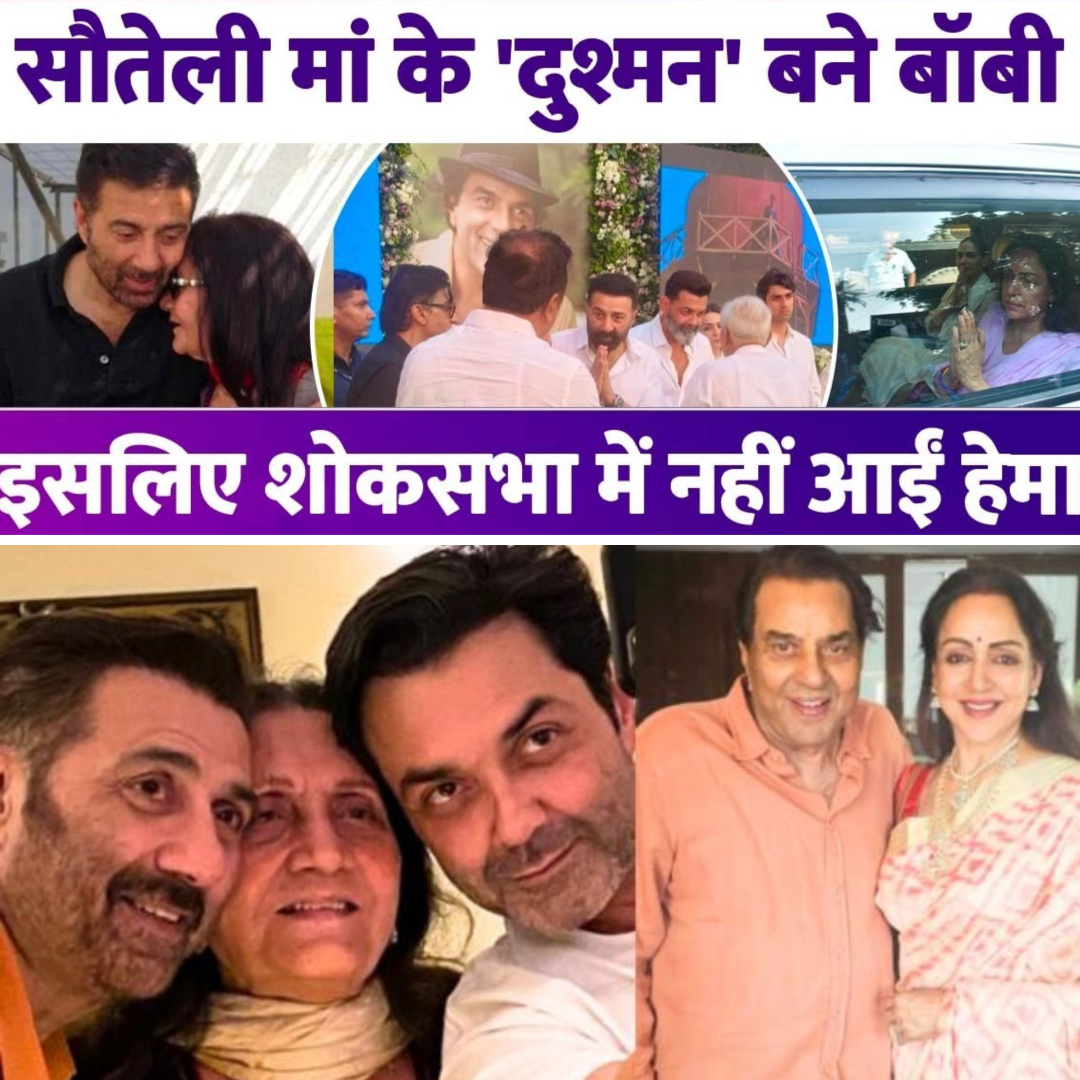
Could Sunny and Bobby Deol’s Ego Have Contributed to Dharmendra’s Final Days? Shocking Family Revelations
The corridors of Bollywood whispered with a tension that had nothing to do with lights, cameras, or scripts. The Deol family, one of cinema’s most storied dynasties, was facing a reckoning that had stayed buried behind smiles, film premieres, and carefully curated Instagram posts. Dharmendra’s death had been sudden for some, inevitable for others, but no one had predicted the quiet storm that would erupt in the aftermath—a storm that now carried names, egos, and unspoken truths.
In the grand yet austere home of the Deol family, sunlight filtered through heavy curtains, casting long shadows across polished floors. It was a space that had seen celebrations, laughter, and the glitter of celluloid fame. Today, it was thick with tension. Hema Malini, poised yet visibly weary, moved through the rooms like a general surveying her troops, every gesture precise, every glance measured. Her eyes carried the weight of decades of silence, patience, and discreet resilience.
Sunny and Bobby Deol were already in the drawing room, seated at opposite ends of a vast sofa, their expressions a carefully constructed mix of sorrow, irritation, and restrained defensiveness. For years, the brothers had projected confidence, even arrogance, as if their lineage guaranteed privilege, success, and entitlement. But today, the walls of the Deol home, soaked in memories of laughter and cinematic triumph, seemed to echo with a different authority—the authority of the man who had built it all and now, through his will, was commanding their attention even in absence.
Dharmendra’s last testament, revealed only to a handful of trusted family members and lawyers, was not just a list of possessions and allocations. It was a map of legacy, a carefully measured orchestration of influence and respect, and a direct challenge to the egos of his sons. Among its clauses were instructions that ensured Hema Malini, who had long been positioned in the public eye as the “second household” figure, held a position of respect and decision-making authority—something that immediately rattled Sunny and Bobby.
“What do you mean she gets the say?” Sunny muttered under his breath, the words loud enough to carry into the silent room. His jaw tightened, fingers clenching the armrest of his chair. Bobby’s eyes were fixed on the floor, jaw set, as though staring at the polished wood could prevent him from confronting the uncomfortable truth. For a moment, the room seemed to hold its breath. It was not the presence of the cameras, the media, or the buzzing phones of social media that commanded the tension—it was the moral and emotional authority of Dharmendra’s will itself.
Hema Malini, seated at the head of the arrangement, did not rise to the bait. She did not flinch, did not raise her voice, did not let the air crack with confrontation. Her composure was not born from fear; it was the product of decades of navigating a world where every gesture, every choice, was scrutinized. She had been a partner in love, an observer of pain, and a keeper of secrets. Today, she was the executor of a legacy, and her quiet authority was impossible to ignore.
The will had other stipulations—specific instructions about charitable contributions, the management of Dharmendra’s vast estate, and even subtle guidance on family reconciliation. There were messages intended not just to distribute wealth, but to mend old wounds and challenge long-held assumptions. Sources revealed that some clauses explicitly encouraged Sunny and Bobby to acknowledge Hema Malini’s role—not as a concession, but as recognition of partnership and respect. For men who had long defined themselves in opposition to anyone challenging their perceived primacy, the instructions felt like a rebuke, a quiet correction from beyond the grave.
In the kitchen, staff moved silently, aware of the fragile dynamics in play. Every whispered word carried weight; every glance might be misread. It was here, in the interstitial spaces of a home filled with fame and history, that the human drama unfolded with the intensity of a film climax. Hema Malini walked through the room, her steps measured, her mind calculating the reactions of each family member. Her presence was calm, but it carried an unspoken gravity—the kind that comes when a person knows exactly what they are entitled to, what they must defend, and what the consequences will be for silence or resistance.
Outside, the city moved obliviously, the hum of traffic a stark contrast to the charged atmosphere inside. Fans speculated, social media erupted, and news outlets scrambled for details, but the truth was intimate, contained, and raw. The story was not about fame or scandal; it was about legacy, authority, and the emotional inheritance left behind by a man whose life had spanned decades of cinema, love, and complex human relationships.
Conversations that were once casual now carried layers of meaning. A reference to a property, a subtle nod to past disagreements, a seemingly innocuous remark about finances—all of these became signals in a delicate negotiation of ego, respect, and remembrance. Hema Malini’s strategy was simple: maintain dignity, assert rightful authority, and allow the weight of Dharmendra’s words to speak for themselves. Every decision, every movement, was calculated to honor his intentions, even when it caused discomfort to those who had never questioned their assumptions before.
Sunny and Bobby found themselves navigating a new landscape—a world where their father’s final instructions had not only redistributed material wealth but also recalibrated the moral compass of the family. For the first time, the automatic dominance they assumed as sons of a legendary actor was questioned, not by outsiders, but by the silent, unyielding authority of Hema Malini. The brothers, accustomed to public adulation and unquestioned influence, were forced to reckon with a system of respect that did not center them.
And yet, despite the tension, despite the unspoken accusations and simmering frustrations, there was a subtle current of reflection. Hema Malini’s presence, steady and unwavering, reminded them all that Dharmendra’s legacy was not solely about fame or fortune. It was about love, partnership, and the careful balance of personal and familial integrity. The will, controversial to some, was in truth a masterclass in human understanding—a final lesson from a man who had lived fully, loved deeply, and planned meticulously, even from beyond the grave.
As evening descended, casting long shadows across the Deol estate, the family remained in delicate equilibrium. Words were carefully chosen, movements deliberate, and every glance carried unspoken acknowledgment of the shifting dynamics. The media speculated endlessly, but the true drama was contained within these walls: a story of legacy, ego, love, and respect, unfolding quietly, with emotional stakes higher than any blockbuster could convey.
By nightfall, Hema Malini retired to her private quarters, exhausted but resolute. She had navigated a day filled with tension, ego clashes, and public speculation, yet she had preserved the essence of Dharmendra’s final wishes. In her hands rested the quiet power of authority, the responsibility to uphold a legacy, and the knowledge that some truths, some reconciliations, must unfold in silence, far from prying eyes.
The Deol family saga, already legendary, had entered a new chapter—one defined not by reels or scripts, but by human complexity, the weight of inheritance, and the extraordinary subtlety of love and respect played out in the private theater of the heart. And in that silence, in the stillness of a household balancing grief, legacy, and the challenges of ego, the true magnitude of Dharmendra’s influence was felt—not in celluloid, but in the lives he had shaped, guided, and now, from beyond, commanded with finality.
The morning after the first revelations of Dharmendra’s will, the atmosphere in the Deol household was electric with unease. Even the servants, accustomed to the ebb and flow of celebrity life, moved with cautious precision, as though one misstep could set off an emotional avalanche. Hema Malini, seated in the grand living room surrounded by family portraits that chronicled decades of cinematic triumph, remained composed. But her eyes, deep pools of calculation and memory, betrayed the weight of responsibility she now carried—not just as Dharmendra’s wife, but as the executor of his final vision.
Sunny Deol paced the length of the drawing room, fists clenched and voice low, muttering to himself as though rehearsing arguments that had no audience. Bobby, quieter but no less conflicted, hovered near a window, staring out at the sprawling gardens that had been silent witnesses to the family’s many dramas. Both men had been raised in the shadow of their father’s immense charisma and influence. They had grown accustomed to an unspoken hierarchy where they commanded attention simply by virtue of their bloodline. But now, for the first time, that unchallenged dominance had been questioned.
Hema Malini’s voice, calm and deliberate, cut through the tension. “The clauses are not negotiable,” she said, her words carrying both finality and a subtle authority that demanded recognition. “Your father’s instructions are clear. He valued respect and unity, and these directions reflect that.”
Sunny’s lips pressed into a thin line. “Unity? This is ridiculous,” he said, his tone a mixture of incredulity and frustration. “Why should decisions that involve the entire family give priority to you?”
Hema’s gaze did not waver. “Because your father intended it that way,” she replied evenly. “And because respect, once earned, does not expire with death.” Her words were precise, almost surgical, leaving no room for argument. The silence that followed was thick, heavy with the weight of history, ego, and unspoken grievances.
In a quiet corner of the room, Esha Deol observed the unfolding drama with a mixture of sadness and quiet resolve. She had always admired her father, not only for his legendary career but for the unwavering principles that guided his life. She understood that the moment required patience and poise, qualities that her father had tried to instill in her throughout her childhood. And as she watched her older brothers wrestle with ego and authority, she felt a growing determination to honor his legacy in her own way.
The day wore on with tense discussions, punctuated by bursts of frustration and quiet resistance. Sunny and Bobby challenged various clauses, from property distributions to decision-making powers, their voices rising and falling like waves against a rocky shore. Hema Malini, however, remained unwavering, presenting the will as both shield and sword—a document that carried the weight of Dharmendra’s voice, a voice that had guided them all for decades.
Late in the afternoon, the atmosphere shifted subtly with the arrival of legal advisors who had been entrusted with the execution of Dharmendra’s last testament. Their presence introduced a new layer of authority, one that was procedural rather than emotional. The advisors began walking through each clause, explaining legal implications, clarifying intentions, and carefully documenting reactions. For Sunny and Bobby, the presence of these neutral, factual voices introduced an element of accountability that they could not ignore. Every objection, every challenge, was met not with debate but with the measured precision of legal inevitability.
Meanwhile, the public and media frenzy intensified outside the walls of the estate. Fans speculated endlessly about the implications of the will, Hema Malini’s newfound authority, and the reactions of Sunny and Bobby. Headlines splashed across social media: “Hema Malini Takes Charge of Dharmendra’s Legacy,” “Sunny and Bobby Deol Clash Over Will,” “Secrets of the Deol Family Exposed.” But within the household, these external pressures mattered little compared to the raw, unfiltered reality of human emotion, grief, and the unspoken bonds of blood.
It was during a brief interlude in the afternoon that Esha Deol quietly approached Hema Malini. In her hands was a small, folded letter, penned by Dharmendra himself in a voice that had always been gentle, yet commanding. The note contained words meant not for public consumption, but for those who truly understood the meaning of legacy. Hema Malini took the letter, reading it silently, and a faint nod acknowledged the depth of its message. It spoke of love, respect, reconciliation, and the importance of carrying forward a family’s honor with dignity.
The quiet moment between mother and daughter contrasted sharply with the heated exchanges elsewhere. It was a reminder that beyond ego, wealth, and public spectacle, there existed an intimate, personal understanding—a connection that transcended the turmoil of inheritance and legal intricacies.
As evening descended, the tension remained palpable, but subtle shifts in demeanor suggested that the storm, while far from over, was beginning to find its channel. Sunny and Bobby, though still resistant, had started to recognize the immovable authority of the will and Hema Malini’s role in executing it. Esha, for her part, moved silently through the rooms, a bridge between the generations, carrying with her the quiet authority inherited from her father.
By nightfall, the household settled into an uneasy calm. The discussions, arguments, and legal reviews had consumed the day, leaving an exhausted, emotionally raw family in their wake. Hema Malini retreated to a private room, reflecting on the enormity of her responsibility. She knew that the coming days would require continued patience, careful negotiation, and an unwavering commitment to the principles her late husband had left behind.
Yet, amid the tension and grief, there was a sense of clarity. Dharmendra’s will was more than a legal document; it was a roadmap for respect, unity, and accountability. It was a final lesson, imparted with the subtle authority of a man who understood the weight of legacy and the importance of navigating human emotions with precision.
And somewhere in the quiet corners of the estate, Esha Deol read the note again, letting the words sink in. She knew that honoring her father would require more than compliance with legal instructions—it would require courage, empathy, and the strength to act when others faltered. It was a challenge she was ready to accept, not for public recognition, but because the legacy she carried demanded it.
The next morning, the media storm surrounding the Deol family reached a fever pitch. Photographers stationed themselves at every conceivable vantage point near the estate, while journalists and social media influencers speculated endlessly about the private moments that had transpired behind closed doors. Headlines splashed across screens and newspapers alike: “Hema Malini Takes Control of Dharmendra’s Legacy,” “Family Rift Exposed: Sunny and Bobby Challenge the Will,” “Esha Deol Honors Father in Private Ceremony.” Yet despite the frenzy, inside the walls of the Deol residence, a quieter, more intimate drama was unfolding—one that no camera could capture.
Esha Deol had taken it upon herself to honor her father in the manner he had always cherished: privately, with intention, and with profound respect for the bonds of family. Early in the morning, before any legal meetings or press briefings, she quietly arranged a small gathering in the garden of the estate, Dharmendra’s favorite spot, where the sunlight filtered softly through the trees. She invited only the family members who would understand the significance: Hema Malini, her mother-in-law Prakash Kaur, and herself. Even Sunny and Bobby were kept at a distance, not out of malice, but to preserve the intimacy of the moment her father would have wanted.
The ceremony was simple, yet profoundly moving. Esha lit a single lamp, its flame dancing in the gentle breeze, and placed a small framed photograph of Dharmendra beside it. She recited passages from his personal journal, carefully chosen lines that spoke of love, humility, and the importance of family unity. Tears glistened in the eyes of those present, though none of them spoke, letting the quiet reverence fill the space. This was not a performance for the world; it was a private act of devotion, the kind that only those who truly loved Dharmendra could understand.
Meanwhile, tensions continued to simmer among the siblings. Sunny and Bobby, though restrained publicly, were grappling with the implications of the will. Every clause seemed to challenge their assumptions about their roles in the family hierarchy. For decades, they had been accustomed to deference, their opinions carrying the weight of legacy alone. But Dharmendra’s meticulous instructions and Hema Malini’s unwavering authority disrupted that dynamic, forcing them to confront not only the letter of the will but the values their father had hoped to instill.
Hema Malini, for her part, navigated the storm with remarkable composure. She met with Sunny and Bobby privately, walking them through each clause of the will, patiently explaining the rationale behind every decision. She reminded them that the goal was not to diminish their positions, but to uphold Dharmendra’s vision for the family: a balance of respect, accountability, and unity that transcended ego and personal grievances. Slowly, they began to understand—not immediately, but enough to recognize that this was a matter of principle, not favoritism.
As the days passed, Esha’s quiet actions became a source of reflection for the entire family. She organized small private moments of remembrance, sharing stories of her father that none of the public had ever heard—moments of kindness, humor, and wisdom that revealed a man beyond the glamorous image the world had seen on screen. These intimate acts of devotion fostered a sense of healing, a gradual softening of the tensions that had threatened to fracture the family.
Even the household staff, who had witnessed decades of the Deol family’s private life, noted the change. Conversations grew warmer, the atmosphere less charged with unspoken resentment. Esha’s thoughtful, unobtrusive gestures reminded everyone of the enduring impact of Dharmendra’s love and guidance. The family began to understand that honoring him was not about asserting dominance or winning arguments; it was about carrying forward the legacy of integrity, loyalty, and compassion that he had exemplified.
Public curiosity remained at a peak. Social media was awash with speculation: Why had Esha acted privately? What were the specific clauses of the will that had caused friction? How was Hema Malini managing the family’s affairs? Yet behind the scenes, the family’s true priorities had shifted. They were no longer focused on public perception or media narratives. They were focused on each other, and on honoring a man whose influence extended far beyond the cinematic screen.
In a particularly poignant moment, Esha invited her brothers to join her in a brief private remembrance in the garden. At first, Sunny and Bobby hesitated, their pride and public persona battling against the intimacy of the setting. But as Esha recited one of their father’s personal reflections about courage and humility, they began to soften. The morning sun fell across their faces, illuminating not only the garden but a sense of reconciliation. It was not dramatic or theatrical, but quiet and meaningful—the kind of moment that would stay with them for the rest of their lives.
Hema Malini observed the scene with a sense of quiet satisfaction. She had assumed the role of mediator, guardian, and executor, and in that role, she had guided the family toward understanding. The public may have seen only headlines and speculation, but within the estate, true healing was taking place. The Deol family, despite decades of complexity, ego, and rivalry, was beginning to find balance once more.
By the time the sun set, the Deol family had emerged from the intensity of the past days with renewed perspective. The will’s legal implications had been clarified, public relations had been managed, and, most importantly, the personal and emotional needs of the family had been addressed with respect and care. Dharmendra’s legacy, both material and moral, had been honored in a way that transcended headlines, gossip, and social media frenzy.
Esha Deol’s quiet, devoted actions became emblematic of the lessons her father had taught: that true legacy is measured not by wealth or public acclaim, but by the love, integrity, and respect one leaves behind. And in the heart of the Deol household, amid laughter, tears, and reflective conversation, the family found a way to move forward together—bound by shared memory, guided by principles, and inspired by a man whose life had touched millions.
As Bollywood’s cameras turned away, the Deol family remained behind closed doors, living the truths that the world could never fully understand. It was a story of loyalty, courage, and devotion—a story that honored Dharmendra in the most profound way possible: through the actions and hearts of those who loved him most.